
BOOK REVIEWS — Queer Lens: A History of Photography.
Paul Martineau (Editor) and Ryan Linkof (Editor), Getty Publications, 2025.

Created to accompany the J. Paul Getty Museum’s 2025 exhibition Queer Lens: A History of Photography, this volume recounts the history of queerness and photography, emphasizing how interconnected and impactful each has been on the other. Including 157 photographers and over 200 plates, this book is an exhibit catalogue, a history, a retrospective, a collection of essays, and a celebration of queerness. Paul Martineau, curator of the exhibit and photography curator at the Getty Museum, co-edited this volume with Lucas Museum curator Ryan Linkof.
In the foreword, Potts states that the intentions of the book are to make queerness “radically visible.” This is reflected throughout the volume. Following this, the introduction by the co-editors presents the context of this volume and the exhibit’s creation. The volume is then broken up into loosely chronological and themed sections, each with an accompanying essay, and concludes with an afterword by Catherine Opie. The essays corresponding with the photographs are:
Jordan Bear’s "'Nothing but a freak convention': Queer Photography’s Hybrid Origins, 1839-1900"
Ken Gonzales-Day’s "Photography and the Queer Imaginary, 1901-1945"
Alexis Bard Johnson’s "Queer Visibility: Photography in American Print Culture, 1946-1980"
Derek Conrad Murray’s "Seeing the Overlooked: Blackness and the Queer Self-Portrait, 1981-2020"
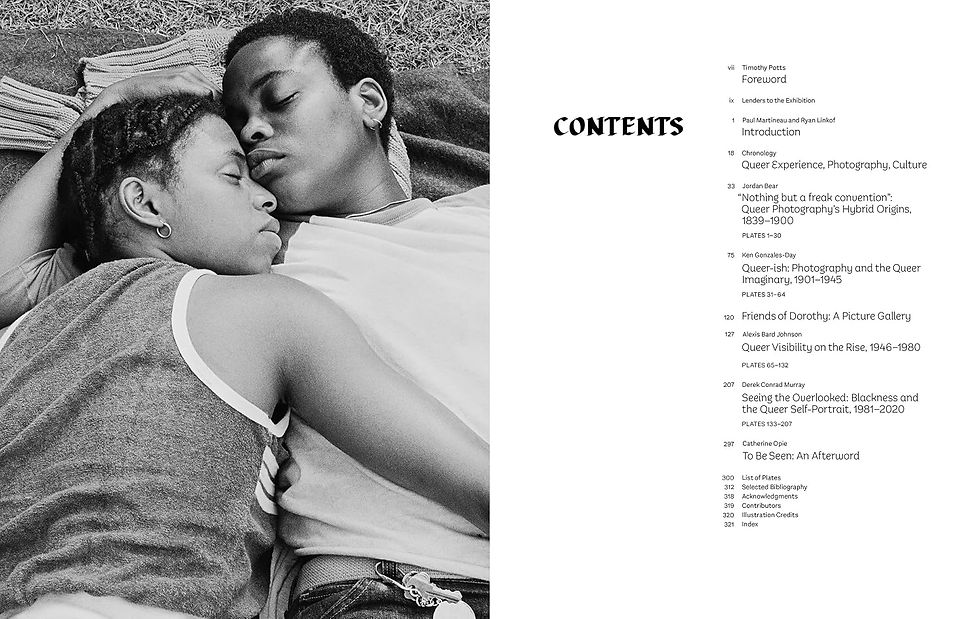
Following the introduction, a select timeline with pivotal moments in queer history and photographic history is presented. Martineau and Linkof make it abundantly clear that the word queer is chosen deliberately, expanding on the term’s history, reclamation, and their choice to use it. Throughout the introduction and timeline, there is an emphasis on the language of queerness. The timeline itself begins in 1732 with the first recorded use of the word lesbian.
The introduction and first essay by Jordan Bear do an excellent job of situating the book within the art history canon by broadly explaining the history of photography through examples connected to queer history, such as Thomas Eakins’ use of photographic references and rejection by his patron for Swimming, 1885, and the Pictorialism movement. Literally book-ending this discussion of the construction of the historical canon is the final essay by Derek Conrad Murray. Through analysing the work of mixed-media artist Darrel Ellis, Murray applies Michel Foucault’s concept of truth-telling to call for historians to self-reflect and give proper dues to Black artists who, like many people of color, have been deliberately excluded from both the canons of art and queer history. At the same time, Murray pulls on the construction of identity, another central theme explored throughout Queer Lens, adding a self-reflective critique to the text. Murray urges a more conscientious use of identity-focused approaches to history, arguing that while it can at times be affirming, it can also be tokenizing. Martineau and Linkof are conscientious of tokenization and deliberately chose artists whose stories centered BIPOC, differently abled people, and trans people. However, the material and history included are primarily from the United States of America, with prominent figures and moments from Europe and Canada, and largely of white people or by white people. Martineau and Linkof also acknowledge this and have deliberately added African, Asian, Central American, and Asian artists while admitting that this does not represent queer life in those geographic regions. While a focus of this work is to document the existence of queer history, the limited scope of creators from beyond North America and Europe draws attention to the persecution faced by queer people across the globe. The editors hope that this work will inspire more books like it about these regions, but with twelve countries still imposing the death penalty for same-sex relationships (Human Dignity Trust), one cannot help but wonder how many queer artists are being lost today.
Throughout this volume are the themes of the power of photography as a tool for visibility, activism, self-expression, construction of identity, performance, and documentary evidence. For the queer community, this is proof of existence, community, connection, and love in the face of societal persecution, erasure, and shame. This theme is evident in Friends of Dorothy: A Portrait Gallery, a strikingly intimate selection of portraits within the broader curation. This theme is then cross-examined by Ken Gonzales-Day, who discusses how, because of the persecution of queerness, the reconstructive process of establishing queer history is inherently filled with doubt due to intentional vagueness and misdirection for the sake of safety. Historians can heavily infer but cannot know for certain the sexual preference or gender identity of those long gone, thus casting shades of doubt on the narrative of early queer history and the power of photography as evidence. But as Gonzales-Day states: “these many fragments offer a radical vision of the future of photography -- not simply as a window into the past or a site of nostalgia or loss but as a portal into our mutable present and our queer futures.”
Queer Lens prioritizes queer photographers but does include non-queer photographers if they demonstrate a genuine care for the queer community or if the photograph serves as an example of a pivotal point in the history Martineau and Linkof are constructing. The volume includes photographs of nudity and sexual acts, but a deliberate choice was made not to include photographs considered pornography, though pornography’s impact, particularly in print culture, is discussed in the context of queer-made publication by Alexis Bard Johnson.
There are many more things to be said about this volume, such as how it discusses the impact of the AIDS epidemic and the use of photography in activism, but that is beyond the scope of this review. This volume is a celebration of queerness throughout history recorded in photographs, and while it has shortcomings that even the text is aware of, it is a wonderful addition to the canon of history. It leaves no room for future generations to doubt that queer people exist here and now.
Rhiannon Allen-Roberts, Archivist.
Note: I did not attend this exhibition and can only add my comments on the book itself and not how it is understood in dialogue with the physical exhibit in Los Angeles.


Comments